


Hello everyone,
Welcome to another episode of Unruly Figures! I first came across the story of Eve Adams on social media, where a lot of kind-of true stories and outright lies about her tend to float around. I had been hoping to cover her for a while now, but it wasn’t until I found out that Jonathan Ned Katz wrote a biography of her that I felt comfortable that I would be able to separate fact from fiction.
Enjoy!
🎙️ Transcript
We’ve covered many large lives and famous stories of queer folks, but hidden in the annals of history are others who led lives that are less well-known but no less important. Today, I’m covering one of these women who was bold, lived life on her own terms, and—tragically—suffered for it.
Hello everyone, welcome to Unruly Figures, the podcast that celebrates history’s greatest rule-breakers. I’m your host, Valorie Castellanos Clark, and today I’m covering the tale of Eve Adams, an author and businesswoman who operated a haven for lesbians in New York in the 1920s. Her 1925 book, Lesbian Love, is one of the earliest examples of American lesbian literature—but it also attracted the FBI’s attention and ended up getting her deported.
Before we jump into this tale of tea and obscenity, I first have to thank all of the paying subscribers on Substack whose patronage helps me make this podcast possible. I also want to thank historian and author Jonathan Ned Katz, whose biography, The Daring Life and Dangerous Times of Eve Adams, I’ve heavily relied on for this episode.
All right, let’s hop into it.
Eve Adams was born Chawa Zloczower (KHAH-vah zlo-CHE-ver) on either March 31, 1891 or June 27, 1891 in Mlawa, Poland.1 I’m not sure what’s up with the two different possible dates—usually when a birth date is unsure, we get just a vague month or year, but this is both oddly specific and strangely imprecise. She was the eldest of 7 children; her father, Mordechai, was a grocer; her mother, Miriam, was a homemaker. Poland was still part of the Russian Empire at this point, so she was technically Russian, though I think she would have said she was Polish.
Not much is known of her childhood, though she must have had a decent education. She is noted for having spoken 7 languages: Polish, Russian, Hebrew, Yiddish, English, French, and German. And while Europeans are often at least bilingual today, to pick up 7 languages in the 1920s without any instruction seems unlikely to me.
She was also exposed to revolution early—Poland was practically “seething politically” in the early 20th century.2 In 1905, when Adams was about 14 years old, the Polish Revolution against Russian autocracy began, and the czar granted some political reforms to quiet the revolutionaries down. Her small town had a population of about 15,700 people, about 7,000 of whom were Jewish and experiencing persecution from Russia.3 The Zionists on one side and the secular socialist General Union of Jewish Workers clashed politically and publicly; Adams would have been at least aware of these debates and fights.
On May 25, 1912, she boarded the ship Vaderland in Antwerp, Belgium. Always full of wanderlust, she had purchased a second-class ticket and was moving to the US. Her ticket had cost $52.50 at the time, about $1,400 in 2021.4 She had family in the US already; her maternal uncle, Alexander Migdall, had already immigrated and was financially successful. He probably also paid for her ticket. She landed in the US on June 4 with $23 in her pocket, or about $600 today.5 She was also listed as “Hebrew” for Nationality and “Tailoress” for Occupation.6 She soon Anglicized her name from Chawa to Eve; it would be a few more years before she took on Adams as her last name; a reference, of course, to Adam and Eve.
Initially, she moved in with another uncle, Isidor Meegdall, in Brooklyn. After securing a job in a factory, she moved to New York City and lived with friends for several years. There she fell in with a group of anarchist organizers working on the monthly anarchist journal, Mother Earth, published by Emma Goldman and Alexander Berkman. There, she also became friends with Ben Lewis Reitman, the birth control advocate. In a memoir titled “Eve,” Reitman described his friend as short and red-headed. He also documented her love affairs with women, stating they began “accidently” [sic] after “several experiences with men” left her unsatisfied.7 He implies also that she may have become pregnant by one of these men and had an abortion, which almost killed her.8 Reitman, a medical doctor who often performed then-illegal abortions, may have performed the procedure, or may be conflating stories as part of a claim that he could tell a story about “the ease with which a normal girl develops into a homo, and the serious consequences.”9 This all sounds negative, but the Reitman goes on to describe it all positively; he is a complicated figure and clearly had a complicated relationship with queer women, for sure. Unfortunately, he is also one of the best sources we have on Eve Adams’ life.
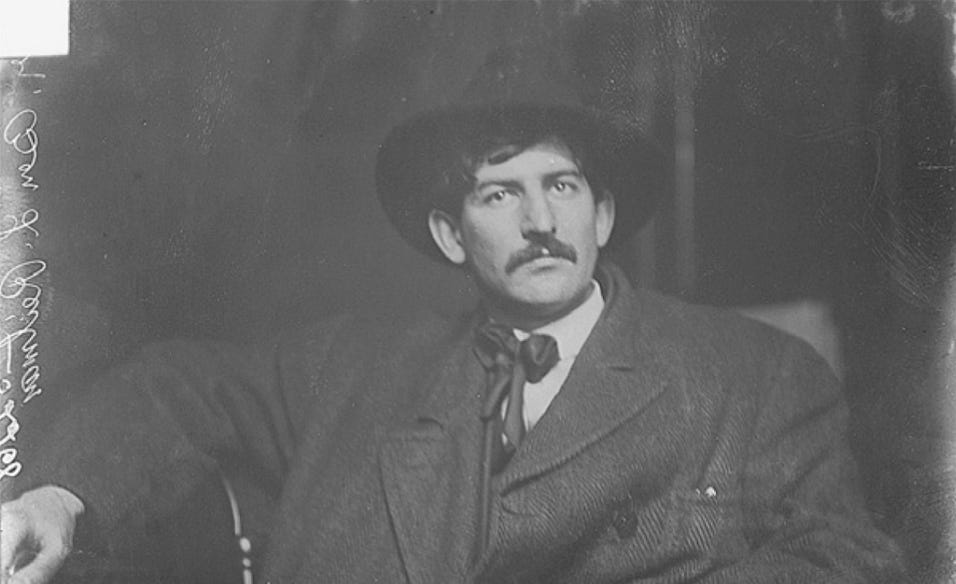
Reitman also documented Adams’ dislike of factory work, saying she “found comfort in the radical labor movement” after she grew tired of factory life.10 By 1919, she was “tramping around the United States selling anarchist, socialist, communist, and radical labor publications.”11 There was a growing number of these “hoboettes” as sociologist Nels Anderson called them; single women who were “bored to death with conventions, anxious to do something new,” and so lived an almost migratory life shuttling around the US, making a living as they went.12 In an interview with Smithsonian Magazine, Adams’ biographer Jonathan Ned Katz notes that while “she found a way to make a living selling radical literature about the things that were wrong in the country […] she never made much money. She was always busy making a buck.”13
In July 1919, we have the earliest documentation of her adopted last name, Adams. It comes in a report to an agent of the Bureau of Investigation—the nascent FBI—that Adams was in Waterbury, Connecticut. She adopted Adams as a last name as a reference to Adam and Eve, a way of saying that she was neither male or female but a third sex, an identity similar to today’s nonbinary identity. This surveillance of Adams was the first known instance, and it came as a result of her political connections and work.
In August of 1919, US Attorney General A. Mitchell Palmer created a “Radical Division” in the Bureau, which was tasked with collecting data on "dissenters” in American life—basically anyone politically liberal who criticized American capitalism.14 A young John Edgar Hoover was appointed to the head of the new division and immediately started creating one of his famous lists of enemies.
The next year, Radical Division tracked Adams as she made one of her circuits of the US to sell radical literature. They had cultivated several informants in major cities, so tips came in about her Butte, Montana, Portland, Oregon, San Francisco, California, Salt Lake City, Utah, and more. The Division also began to spread rumors, claiming that she was planning to “report to the ‘leaders’” in Russia after her circuit took her back to the Eastern seaboard in 1920.15 Obviously, this is a symptom of the US government’s struggle to believe in homegrown Communists/Socialists/leftists; they assumed anyone with a criticism of the US must all an agent of Soviet Russia and the Bolsheviks. Although she did visit her family in Poland, the rest of this is completely made up.
On at least two occasions, Bureau agents broke into Adams’ hotel rooms to read through her mail and go through her belongings, which was a violation of her Fourth Amendment rights. They weren’t very subtle about it—in at least one instance, they confiscated papers from her. Instead of demanding them back, she slipped away before they could try to make an arrest. After that, she stopped traveling with anything damning, sending papers on ahead of her instead.
By all accounts, Adams was indefatigable; stories mythologized her as going on “seventy-five mile stroll in the morning [and] a swim across the English Channel in the evening.”16 She had a reputation of being one of the most convincing salespeople in the business and getting more subscriptions for the left-leaning publications she sold than anyone else.
Perhaps growing tired of traveling, Adams settled in Chicago in 1922 and stayed for a couple of years. She taught Russian lessons or, at least she tried to; it’s unclear how successful this was. She also began the paperwork to become a US citizen in September 1923, more than 11 years after she landed in New York. For a while, she co-managed a tearoom called The Grey Cottage in the bohemian neighborhood Towertown. It was a refuge for leftist thinkers and a bit of a haven for queer women. Her co-manager was a woman named Ruth Norlander, who seems to have been a romantic partner, at least for a time. At The Grey Cottage, they served coffee, cake, pie, and “setups”—the ingredients for a cocktail if you provided your own alcohol.17 Prohibition was the law of the land by then. Despite this clandestine rulebreaking, the crowd was described as predominantly intellectual—they hosted lectures on Tuesday nights and ”their friends were cast more on the pattern of Edward Carpenter or Inez Milholland.”18
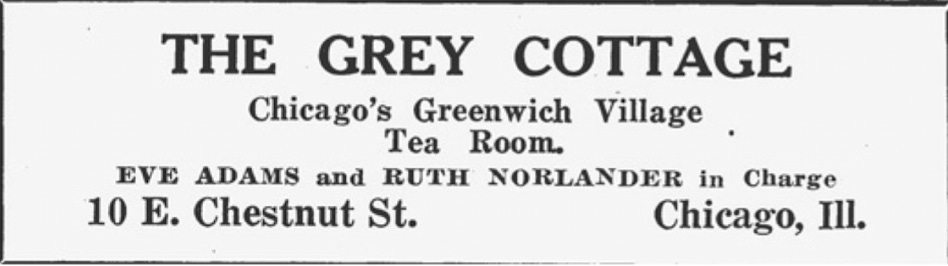
Adams was arrested at the Cottage at least once due to the presence of liquor. The Chicago Daily News reported a fight had broken out and when police arrived, they found a bottle of wine inside. She was released on a fifty dollar bond and the case was eventually dismissed with a warning.19
The Cottage only survived about eight months, but its reputation had spread far and wide by then. I’m not sure why it went under—bad business sense, police issues, or maybe Norlander and Adams broke up. There were also other bars that were also hangouts for the same crowd. The Dill Pickle Club was a particularly famous one in Chicago; Margaret Sanger had given a lecture on birth control there in 1916 and Magnus Hirschfeld had lectured on “The intermediate Sex” in 1931.
Adams left Chicago for New York in 1924. Whether they broke up then or earlier, it seems Norlander and Adams remained on good terms. Later in her life, she wrote to Norlander, calling her “my beloved” and saying “the memories of our beautiful friendship and love keeps me young.”20
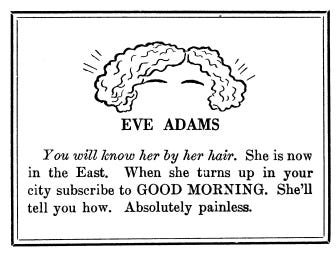
She took whatever she had learned about managing a tearoom and opened a business in Greenwich Village—Eve’s Hangout was at 129 MacDougal Street and open in the evenings.21 On the side, she also did some art modeling, a service she had performed for Norlander in Chicago.
She rekindled her friendship with Ben Reitman, who reported that she was at all the important parties in Greenwich Village. She met numerous people at these parties, but none was more impactful to her future than Robert Edwards, “the Greenwich Village eccentric” who made sure that her business was listed in Mr. Quill’s Guide to Greenwich Village businesses, which Edwards edited.22
Learning from whatever had killed The Gray Cottage, Eve’s Hangout did much better. MacDougal Street had emerged from the 1910s as the cultural and social center of New York’s Bohemian set. It was home to the Liberal Club, the radical feminist Heterodoxy Club, the Washington Square Bookshop, and the Provincetown Playhouse, among others—this was where Eve’s Hangout opened.23 1924 and 1925 had seen some police crackdowns in other parts of the Village, but this part of MacDougal Street remained largely insulated. Like The Gray Cottage, Eve’s Hangout welcomed this Bohemian set, and quickly became known as a place for lesbians to meet and mingle, which was significant in a time when women often struggled to leave the house without male chaperones. In fact, the magazine Variety reported that the tearoom entrance had a sign that read “Men are admitted, but not welcome.”24 This is probably not true, and may even have been an example of the editors at Variety stereotyping all lesbians as “man haters,” but it is hilarious.
Eve’s Hangout quickly became “one of the hottest nightlife spots in New York City’s flapper-era West Village.”25 People have supposed it was a speakeasy, but the lack of charges for serving alcohol—and the police were targeting Adams, as we’ll see—the lack of charges for serving alcohol during Prohibition indicates it really was a tearoom and didn’t serve alcohol.26 Her place was later remembered as “one of the most delightful hang-outs the Village ever had.”27
Also in 1924, Adams put pen to paper. She began writing Lesbian Love, an account of over two dozen women she had met in the queer community. Some describe the book as “amateurish,” but written with a lot of authenticity and love.28 It’s significant that she used the word lesbian in the title—the word was not in common usage, and was only just beginning to lose its derogatory associations.
Though she fictionalized their names, according to Katz, some women in the Socialist movement were pretty upset about this when it was published in February 1925. In the mid-twenties, women in the US could live together without attracting speculation about whether their relationship was erotic—largely because of a belief that women weren’t naturally sexual beings. Adams’ book threatened this community. And despite the fact that she published under the pseudonym “Evelyn Addams,” the book also threatened her.
Since the book was only privately published, however, in a limited run of 150 copies. It seems that it did not immediately snag on the Bureau’s radar, but when Adams planned a trip to Poland in 1925 and requested a permit to leave the US and return from US Immigration, they got caught up on her files. It seems there was some intention to deny her request, but they ended up approving it specifically to put into action a loophole: Leaving the US without getting her naturalization papers first automatically removed some of the legal protections she was guaranteed before. Her biographer, Katz, implies that Adams simply did not consider this when she went home for a visit, but I suspect it’s more likely she didn’t understand that exit and reentry would throw her legal status into limbo.29
Now, her previous anarchist and radical ties were still not enough to deny her reentry or deport her. She was just selling magazines and knew other radicals; she wasn’t putting anything into writing herself. But, in a series of coincidences that sound extremely uncoincidental and instead like there was a plot against Adams stemming from somewhere, in June 1925 a man named Jay Fitzpatrick presented himself to US Immigration on Ellis Island to file a complaint against Adams. He claimed he was there to save young girls, because Adams was seducing them into a life of lesbianism… and if that sounds oddly similar to some of the political rhetoric we hear today, you probably won’t be surprised to learn that Fitzpatrick was a single man in his late 30s—an incel for the early 20th century.30 Some things never change.
It also seems likely he had some connection to a couple called the Calhouns, the landlords of Eve’s Hangout at 129 MacDougal. Although evidence is scant, Katz theorizes that the landlords didn’t like the clientele that Eve’s Hangout was attracting, and/or were anti-immigration themselves and wanted her out of their building. He writes, “Did the Calhouns contact friends in the US government and ask them to initiate legal action against their notorious, noncitizen, radical lesbian tenant? Did Fitzpatrick plot with the Calhouns to inform immigration officials of Eve’s lesbian activities?”31 That Fitzpatrick moved into an artist’s studio in that building not long after all of this went down seems too ridiculous to be a coincidence.
The police conducted at least one raid on Eve’s Hangout that summer. What the outcome of that was is unclear, but certainly Adams was not arrested because she still went to Poland to visit her parents that fall. She began her return journey to the States in November 1925 after a “brief visit” to Poland.32
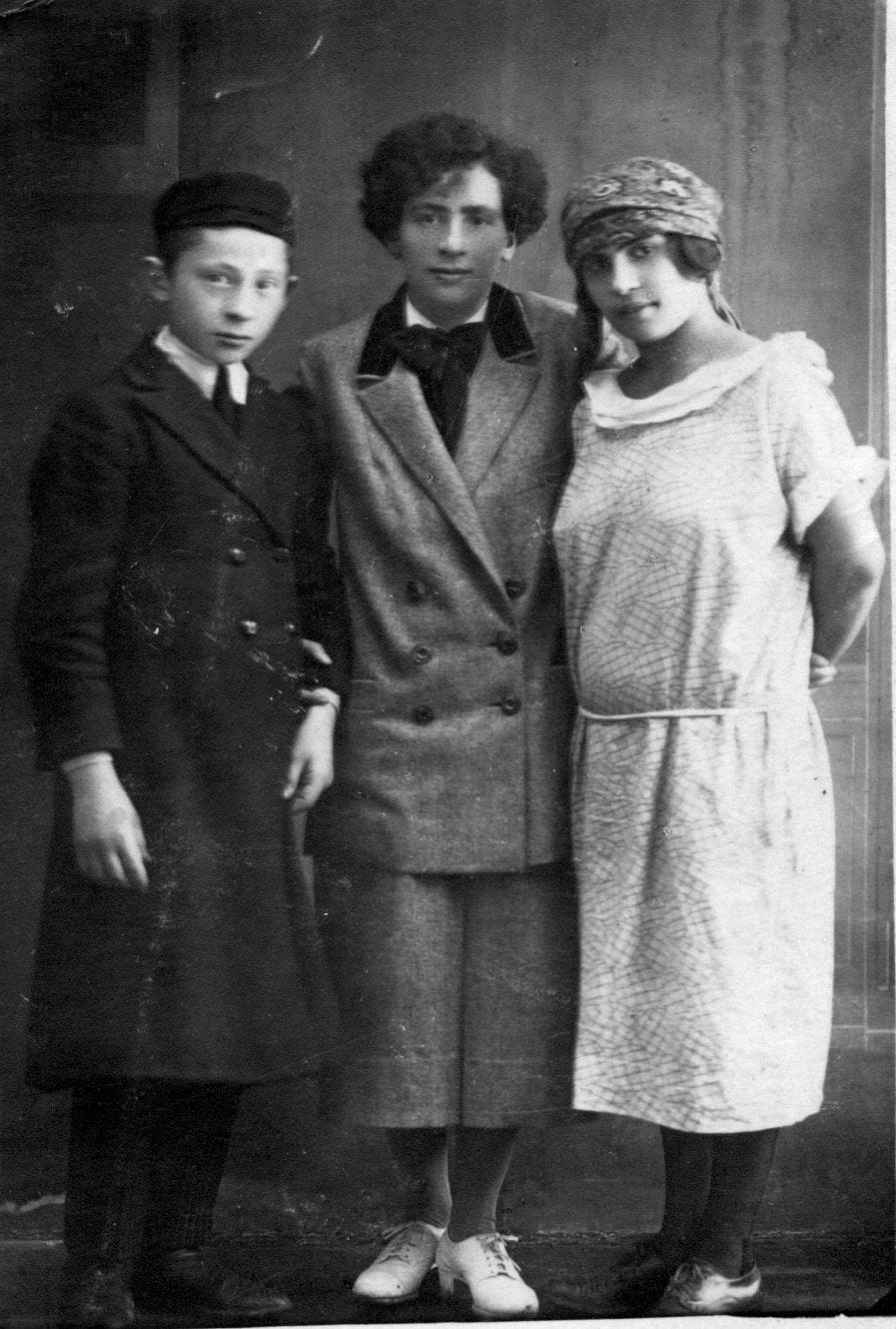
Now, remember Robert Edwards, who I mentioned as the editor of Quill’s? He had turned on Adams as he learned more about her. Despite presenting himself in public as a “unconventional, arty type” he apparently hated all manner of leftists, sexually open people, Jews, women, and especially Jewish lesbians who supported labor rights and dressed in a more traditionally masculine style.33 In 1926, his descriptions of Eve’s Hangout in Quill became disparaging:
Eve’s Hangout—129 Macdougal St., Where ladies prefer each other. Not very healthy for the she-adolescents nor comfortable for he-men.34
So, you know. Yikes. Just dripping with homophobia and misogyny.
On Thursday, June 17, 1926, Adams was arrested in her tearoom by police officer Margaret M. Leonard, accompanied by 4 other officers. Leonard had been sent to entrap Adam by Mrs. Mary Sullivan, director of New York City’s policewomen. Sullivan claimed that Leonard had been “caressed” by Adams in the back of a taxi, been gifted an autographed copy of her “vicious, immoral book,” and then been “the object of [an] attempted ‘indecent act.’”35 Adams was arrested on charges of obscenity and disorderly conduct. A lot of this has the feel of a setup, though we won’t know for sure. She pleaded, of course, not guilty, and her bail was set to $2,500, or about $47,000 today.36
Adams was tried in two separate trials. The first one, on July 2, 1926, was regarding the obscenity charges for Lesbian Loves. I covered some of the obscenity laws created by Anthony Comstock back in November, so I won’t go into a bunch of detail here again. Unfortunately, there is no surviving transcript of the trial because she would have had to pay for it, which is surprising to me. Although there was no transcript and the title of her book was considered so lewd it couldn’t be printed in newspapers, the New York Times nevertheless reported on her trial and her defense of the books as “a scientific literary contribution.”37 She was found guilty by the judge and sentenced to one year in prison, the maximum recommended sentence for the crime. The judge also then made sure to coordinate with other agencies to “take up the matter of deporting” Adams once her sentence was served, further contributing to the idea that there was some sort of conspiracy here.38
Her sentence started on July 6, and then on July 7th, she was brought back to court for her “disorderly conduct” charge for allegedly trying to seduce the police officer Margaret Leonard. Once again, no transcript of the trial exists because Adams would have had to pay for it. We do know that Adams denied ever having met Leonard, but she was found guilty anyway and sentenced to six months in a workhouse.
During her imprisonment, she met actress Mae West, who was serving a 10-day sentence for an obscenity charge related to her play, Sex.39 10 days was the minimum recommended sentencing. You might notice the huge difference in treatment here—West received 10 days, Adams is up for deportation. That’s because West was a beautiful American white woman and Adams was not. Her deportation order was motivated more by anti-Semitic, anti-immigration stances of the 1920s, as well as concerns about her Socialist ties.
For years, rumors lingered that this had all been put in motion by that editor of Quill’s, Robert Edwards. An article in 1931 remembered his “crusade against lesbians in the Village [that] turned the eyes of the ever-willing public on Eve’s notorious hang-out. Bobby’s exposure led to a police crusade to clean up the Village.”40
Regardless of who started this and why, the government workers who wanted her out of the US didn’t wait until her sentence was up before they started working on a case for deportation. They began by insisting her “disorderly conduct” with the police officer was actually prostitution, which justified deportation. Hearings for her deportation began in November 1926.
The legal basis was that she had violated the US Immigration Act of 1917, which provided for the deportation of any alien sentenced to one year or more for a crime of “moral turpitude” that had been “committed within five years of entering the United States.”41 Because she had left the US briefly in 1925, her clock had started again. I think a good lawyer might have been able to argue that because her “indecent” book had been published before she went to Poland, and that she had been in the US for more than 5 years at that time, her crime technically didn’t fit the letter of the law but, it doesn’t look like the argument was tried so no idea if it would have held water.
In her defense, she said,
“I admit having written a book entitled Lesbian Love, based on true acts and living characters of today. . . . The object of the book was to show the exact things that are happening from day to day, and every character contained therein is a true character except she is given an assumed name. I had 150 copies of the book published for private circulation only, particularly among artists and poets of Greenwich Village. At the time of my arrest I just had about ten copies of that edition in my possession, and they were all taken by the police authorities.”42
As her biographer Jonathan Ned Katz pointed out, the private circulation portion is key to her defense. Through those numbers, Adams was arguing that her book had so few readers it wasn’t able to “deprave and corrupt” readers, which was the requirement of obscenity laws in the US at the time.43
Often in these cases, we see people’s families completely abandon them, but that isn’t the case here. The uncle who had bought Adam’s original ticket to the US back in 1912, Alexander Migdall, testified on her behalf. As a married man with children, a naturalized citizen, and a wealthy businessman, his testimony carried a lot of weight. He assured the court Adams could not possibly be guilty of prostitution, and that,
…any book written by my niece, according ot her good character and reputation, could never be immoral. I have kept in close touch with her ever since she came to tge United States, and she has always worked hard for a living in one capacity or another.44
There is actually a full transcript of this trial, much of which is quoted in Katz’s biography of Adams. I won’t quote it at length here, but it is worth noting that her lawyer was clearly inexperienced or inept—he didn’t call out a major witness’s lies or mistakes made under oath. He also accidentally fed details to witnesses for the prosecution.
Unfortunately, Adams had neglected to finish the naturalization process; she never became a US citizen. It’s hard to say why—perhaps she just forgot, perhaps she never had enough money to really spare on the paperwork. Considering her politics though, she may have rejected the state as a legitimizing institution and not seen the point of becoming a citizen. The revocation of citizenship and deportation of Emma Goldman, who had been born in Lithuania, also may have convinced her of the futility of getting citizenship. What did it matter if the government could just take it away? In any case, her lack of citizenship made it easy to deport her.
In the end, she was found not guilty of prostitution, but still recommended for deportation once her prison term was finished. She was deported on December 7, 1927, sent back to Europe aboard the steamship Polonia.
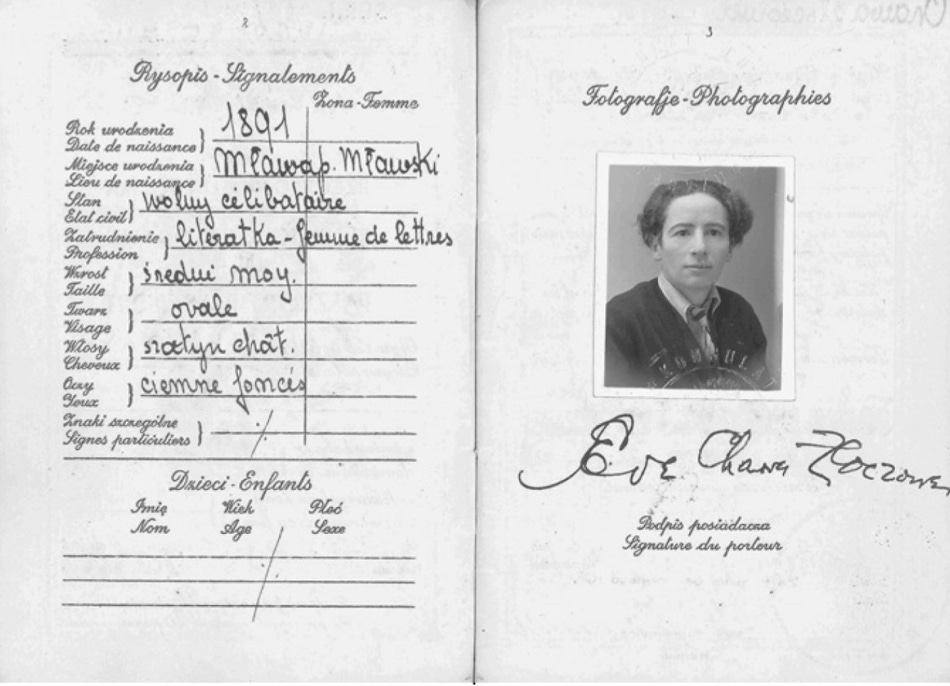
History temporarily loses track of her after this deportation. She wrote to Ben Reitman in February 1929, reporting that she had moved to Warsaw the month before and was working as a governess. She also worked giving English and Hebrew lessons, became a waitress for a while, then worked at a photography company. All positions were extremely underpaid, because the jobs Jewish women could get in Poland were limited by discrimination. It seems clear in a letter to Reitman that she was depressed over what had happened and contemplating suicide.
Back in New York, someone had written a dramatization of Lesbian Love entitled Modernity. It ran for two weeks at Play Mart, an underground playhouse on Christopher Street, but was shut down by the cops before opening to wider audiences.45 Other similar plays that might come under police censorship were opened and closed over the next few months—and then the stock market crash of October 1929 set a whole new nightmare in motion all over the world. Still, Eve became something of a folk hero to queer New Yorkers. Articles in newspapers tried to deride queer culture and lesbians in particular, but read almost like praise today:
Eve Adams, once the queen of the third sex, has fled to Paris where her ‘Le Boudoir De L’amour” on Montmartre attracts the supple tongued sirens of the lesbian element.”46
Just as she had not been a madam in New York, she had not opened a brothel in Paris, but sensationalist news like this “crowned the leftist, radical Eve as Sapphic royalty, a lesbian queen.”47 If it was meant to scare young women off from engaging with queer community, I don’t think it worked.
This does confirm for us that by December 1930, Adams had made it to Paris, where she’d been trying to move for a while. As a more liberal and cosmopolitan city than Warsaw, she was hoping she’d be happier and freer there. She was writing again, stories based on her time in prison for Sam Putnam and scheduled ot be published in his New Review. Unfortunately, the magazine folded before publishing any of her stories and it seems they’re lost.
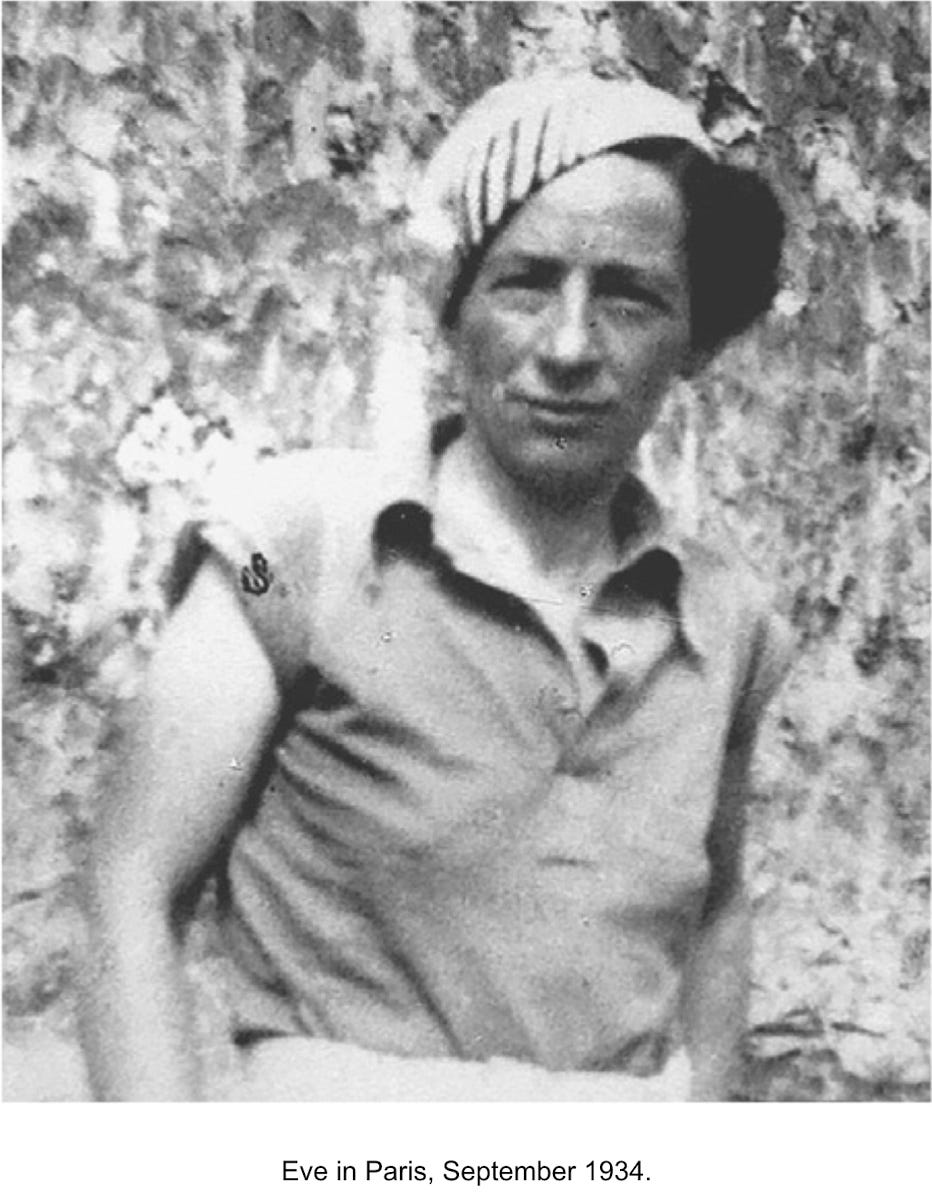
In France, she was able to reconnect with Alexander Berkman and Emma Goldman, who had also been deported from the US. It seems she began working in book sales and for leftist magazines again, like Margaret C. Anderson’s The Little Review. Katz writes that she was “well kown among American expatriate bohemians in Paris as a literary porn peddler.”48 She wrote of being tired of “continually selling Ulysses and Lady Chatterley’s Lover to Americans,” but once people like Henry Miller began buying her books and postcards, she started to make a decent living at it.49
Adams and Miller seemed to be friends of a sort—at least, he sold her his book Tropic of Cancer at the same price he got it from his publishers, so she could make a little extra money selling it as well; later, when Miller started painting watercolors, Adams sold them as well.50 She was not welcome in the homes of other famous lesbians of the literary scene, like Gertrude Stein, Alice Toklas, or Natalie Barney.51 She also didn’t make friends with Sylvia Beach, who saw her selling erotica as competition for the highbrow literary work Beach was selling out of Shakespeare and Co.52
If you’ve noticed the years and are up on your WWII history, you probably know what’s lurking on the horizon. In August 1934, Adolf Hitler declared himself Führer of Germany. The next several years were tense—Adams’ plans to travel further were put on hold for financial reasons as well as concerns about her ability to travel into Eastern Europe as a Jewish woman. Adams stayed in Paris, for the most part, traveling occasionally to London, or the South of France, it seems. She made friends with other members of the Paris literary crowd, like Anais Nïn, and began dating a cabaret singer named Hella Olstein. Adams described their relationship as “fate” and called Olstein “most beloved.”53
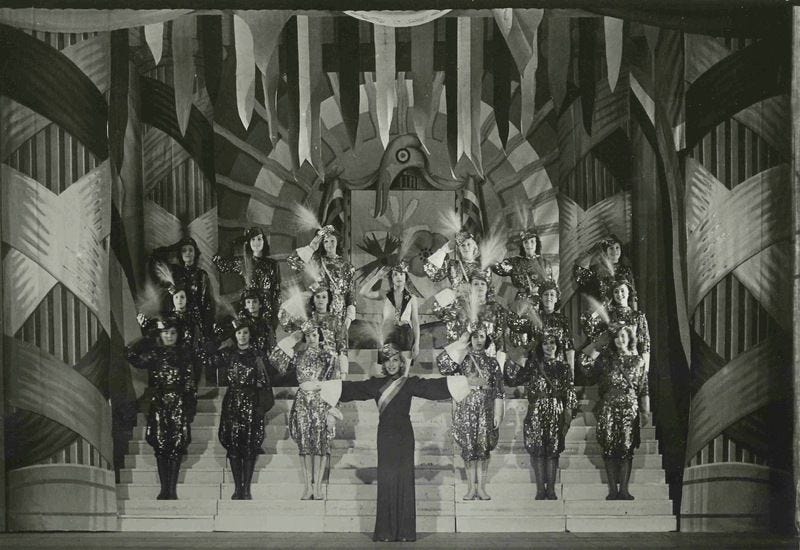
When the Nazis invaded and occupied Paris on June 14, 1940, Adams wasn’t there—she’d been in Nice for a while, then Cannes. On June 15, she wrote to one of her brothers, who had immigrated to Palestine years before, from Biarritz, in southwest France. It quickly became difficult to leave France, and the Adams and Hella struggled to make money.
Writing from Nice, Eve wrote to Ben Reitman, asking him to sponsor her reentry to the US. Anyone wanting to enter needed two sponsors, and she asked him to reach out to her other friends on her behalf. She had no money to pay her fare or other fees, and her wealthy uncle had passed away. By this point, all members of her family left in Poland had been murdered by the Nazis as well, their assets all seized. But even if there had been any chance of the US government allowing her to come back—and there wasn’t—Reitman wasn’t keen to help. In a letter to another friend, Reitman didn’t exactly say he was a Nazi, but he did say “I don’t hate anybody, not even Hitler.”54 In a separate document, he called Adams’ requests for help returning to the US “pathetic.”55 And yet, he still wrote her back, sending her updates about his family and encouragement. Makes you wish she’d seen her “friends” more clearly.
At some point, Adams and her partner Hella got involved with the Marseille branch of l’Union générale des Israélites de France (UGIF-South); a group created by Jewish leaders at the Nazi’s request. The Southern branch, as a result of their distance from Paris and Germany, had enough relative autonomy to undertake illegal and secret rescue work in addition to whatever tasks they had been assigned by the Nazis. We know they were involved mostly through a single receipt dated October 15, 1942 reimbursing them for postage expenses; it’s unclear what Adams actually did for the group.
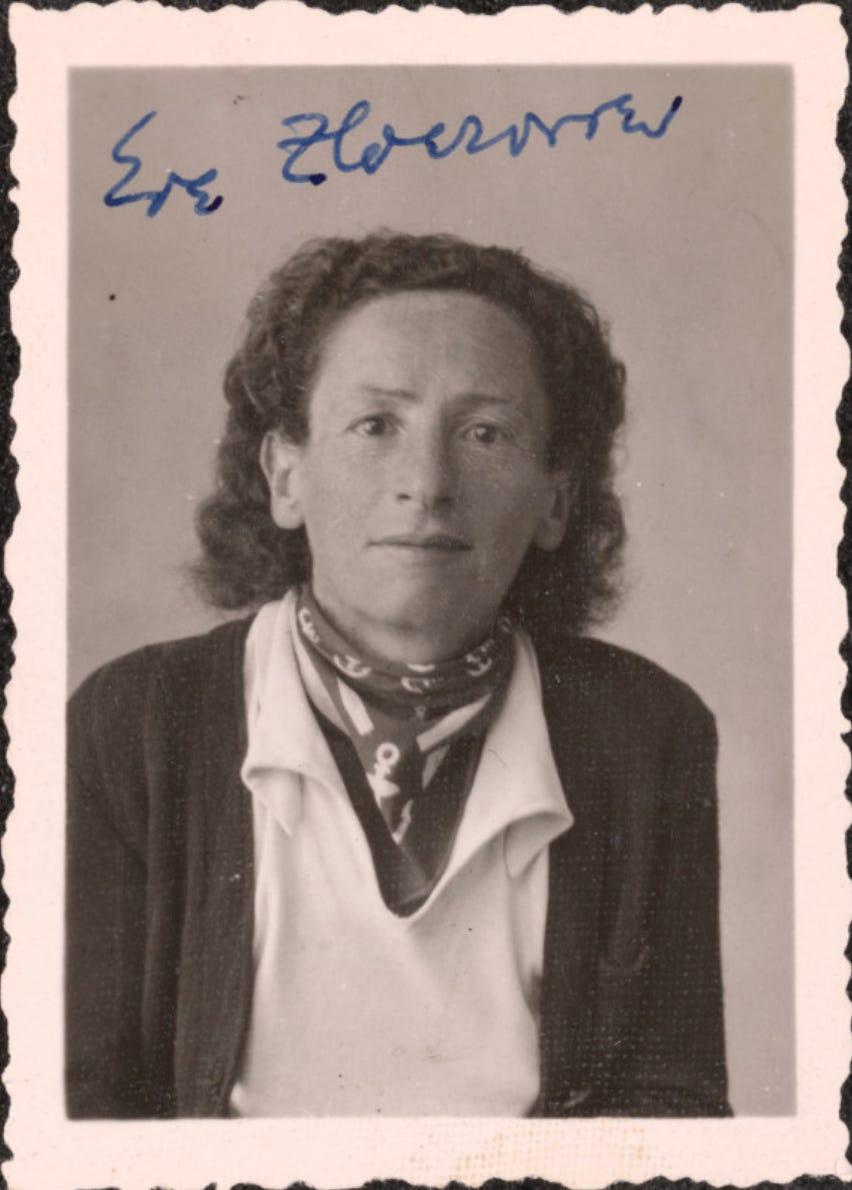
Hella’s letters to her brother in Switzerland are all we know of Adams’ life in 1943. Adams is painted as a homemaker in these letters, while Hella supported them both with occasional gigs singing. Their mail was certainly being inspected though, so nothing more is said of any underground rebel activity they might have been participating in.
On December 7, 1943, Eve Adams and Hella Olstein were arrested. They had managed to evade arrest for 3 years while all around them other Jewish people were deported to concentration camps. Adams was sent to the Drancy internment camp outside Paris first, where she arrived on December 12. Just a few days later, she and Hella were sent to Auschwitz on transport 63 with about 850 other people; several prisoners died along the way. When the transport arrived at Auschwitz, about 505 of those people were gassed immediately, and the rest were selected for work.
We don’t know when Eve Adams died. Most sources list her death as December 19, 1943, which would have been during the journey to Auschwitz. Given the horrors that happened there, I almost hope that she never had to see it. What is known is that when Auschwitz was liberated in 1945, only 6 women who had been on transport 63 were still alive. Eve Adams was not one of them.
I wanted to tell her story not just because she is remembered as a folk hero, but because the combined attitudes of several racist, homophobic, and fascist governments were what killed her. At every turn, Eve Adams was betrayed by the governments she paid taxes to.
Today, back in New York, her former tearoom Eve’s Hangout is an Italian restaurant called La Lanterna. Several drinks on the menu are named after Adams, which I think is a sweet tribute. I’ll be visiting next time I’m in New York. Adams also lives on in the plays of playwright Barbara Kahn, who has written three plays about or including Adams: “The Spring and Fall of Eve Adams,” “Unreachable Eden” and “Island Girls.”56
If you want to read her book, Lesbian Love, it’s not available for sale anywhere, but it is included as an appendix to Jonathan Ned Katz’s biography of her, The Daring Life and Dangerous Times of Eve Adams.
That is the story of Eve Adams! If you liked this story, you will love my book, Unruly Figures: Twenty Tales of Rebels, Rulebreakers, and Revolutionaries You’ve (Probably) Never Heard Of. You can let me know your thoughts about this or any other episode on Substack, TikTok and Instagram, where my username is unrulyfigures. If you’d like to get in touch, send me an email at hello@unrulyfigurespodcast.com. If you have a moment, please give this show a five-star review on Spotify or Apple Podcasts–it does help other folks discover the show.
This podcast is researched, written, and produced by me, Valorie Castellanos Clark. Music is by Danny Wolf of Wolf & Love. If you are into supporting independent research, please share this with at least one person you know. Heck, start a group chat! Tell them they can subscribe wherever they get their podcasts, but for behind-the-scenes content, come over to unrulyfigures.substack.com.
Until next time, stay unruly.
If you liked this episode, you might like one of these episodes:


📚 Bibliography
“Eve’s Hangout.” NYC LGBTQ Historic Sites Project, n.d. Accessed June 15, 2026. https://www.nyclgbtsites.org/site/eve-addams-tearoom/.
Gattuso, Reina. “The Founder of America’s Earliest Lesbian Bar Was Deported for Obscenity.” Atlas Obscura, September 3, 2019. http://www.atlasobscura.com/articles/what-was-first-gay-bar.
Gormly, Kellie B. “America Deported Her for Publishing a Book Titled ‘Lesbian Love.’ Years Later, She Was Murdered by the Nazis for Being Jewish.” History, Arts & Culture. Smithsonian Magazine, June 26, 2025. https://www.smithsonianmag.com/history/america-deported-her-for-publishing-a-book-titled-lesbian-love-years-later-she-was-murdered-by-the-nazis-for-being-jewish-180986864/.
Katz, Jonathan Ned. The Daring Life and Dangerous Times of Eve Adams. Chicago Review Press, 2021.
Palmer, Emily. “Overlooked No More: Eve Adams, Writer Who Gave Lesbians a Voice.” Obituaries. The New York Times, July 2, 2021. https://www.nytimes.com/2021/07/02/obituaries/eve-adams-overlooked.html.
Unruly Figures participates in several affiliate marketing programs, including Amazon, Bookshop, and ShopMy. If you decide to buy anything through affiliate links in this post, I will receive a small commission at no extra cost to you. Thank you for your support!
Emily Palmer, “Overlooked No More: Eve Adams, Writer Who Gave Lesbians a Voice,” Obituaries, The New York Times, July 2, 2021, https://www.nytimes.com/2021/07/02/obituaries/eve-adams-overlooked.html.
Jonathan Ned Katz, The Daring Life and Dangerous Times of Eve Adams (Chicago Review Press, 2021).
Katz, 44
Katz, 10.
Katz, 10
Katz, 10
Katz, 13
Katz, 14
Katz, 14
Katz, 13
Katz, 33
Katz, 33
Kellie B. Gormly, “America Deported Her for Publishing a Book Titled ‘Lesbian Love.’ Years Later, She Was Murdered by the Nazis for Being Jewish,” History, Arts & Culture, Smithsonian Magazine, June 26, 2025, https://www.smithsonianmag.com/history/america-deported-her-for-publishing-a-book-titled-lesbian-love-years-later-she-was-murdered-by-the-nazis-for-being-jewish-180986864/.
Katz, 34
Katz, 38
Katz, 41
Katz, 46
Katz, 49
Katz, 49
Katz, 53
Katz, 54
Katz, 55
“Eve’s Hangout,” NYC LGBTQ Historic Sites Project, n.d., accessed June 15, 2026, https://www.nyclgbtsites.org/site/eve-addams-tearoom/.
“Eve’s Hangout”
Reina Gattuso, “The Founder of America’s Earliest Lesbian Bar Was Deported for Obscenity,” Atlas Obscura, September 3, 2019, http://www.atlasobscura.com/articles/what-was-first-gay-bar.
Gattuso, “The Founder of America’s Earliest Lesbian Bar”
“Eve’s Hangout”
Gormly, “America Deported Her for Publishing a Book Titled ‘Lesbian Love.’
Katz, 56
Katz, 57-8
Katz, 59
Katz, 60
Katz, 62
Katz, 63
Katz, 65
Katz, 67
Katz, 69
Katz, 70
Gattuso, “The Founder of America’s Earliest Lesbian Bar Was Deported for Obscenity”
Katz, 75
Katz, 70
Katz, 1
Katz, 1
Katz, 93
Katz, 108
Katz, 115
Katz, 115
Katz, 119
Katz, 118
Katz, 136
Katz,
Katz,
Palmer, “Overlooked No More: Eve Adams”
Katz, 142
Katz, 142
Palmer, “Overlooked No More: Eve Adams”


